Plays from youtube-nocookie.com once you press play.
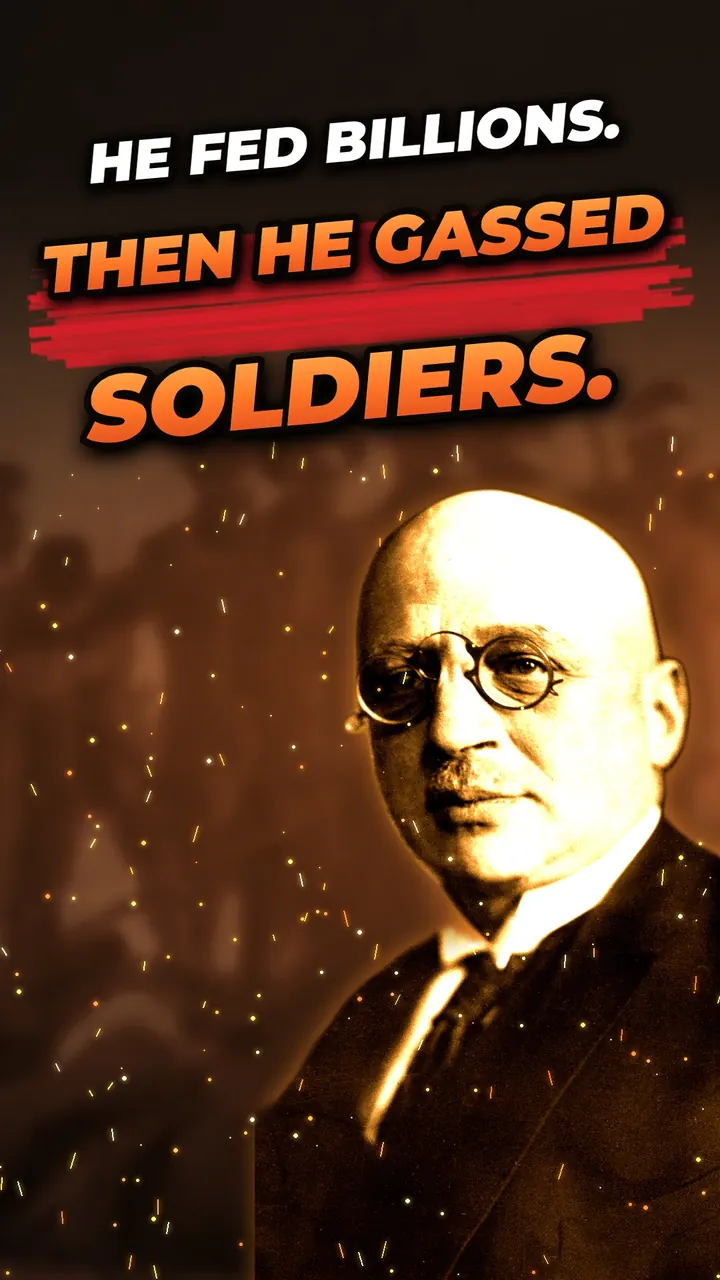
Fritz Haber He Fed Billions. Then He Gassed Soldiers.
In 1909 the German chemist Fritz Haber found a way to turn nitrogen from the air into ammonia: "bread from air", the key to modern fertilizer. In the First World War he championed chlorine gas, and on 22 April 1915 at Ypres he was there when the German army released it. His wife Clara Immerwahr, the first woman to earn a doctorate in chemistry at the University of Breslau, opposed his work. Days later she took her own life. Haber was awarded the Nobel Prize for 1918. As a man of Jewish birth he resigned and left Germany in 1933, and he died in Basel in 1934. Years later, a pesticide that grew out of work at his own institute became Zyklon B.
Was Fritz Haber a hero, or a villain?
The facts behind this file
What the record shows
- In 1909 Haber demonstrated how to make ammonia from nitrogen in the air; BASF, under Carl Bosch, scaled it up from 1913.
- Nitrogen fertiliser from the Haber–Bosch process supports nearly half of the world's population (an estimate).
- He championed and personally supervised the chlorine gas attack at Ypres on 22 April 1915.
- His wife, the chemist Clara Immerwahr, took her own life on 2 May 1915.
- He received the 1918 Nobel Prize in Chemistry, awarded in 1919.
Legends, disputes & careful wording
- Smaller uses of irritant gas came earlier, so the episode calls Ypres the 'first great' gas attack, not the first ever.
- Clara Immerwahr's reasons are debated; the episode only says she opposed his work.
- Zyklon B grew out of work at his institute, but was developed without his direct involvement. Members of his extended family died in the Nazi camps.
Main sources
- Vaclav Smil, Enriching the Earth (2001)
- Erisman et al., Nature Geoscience (2008)
Spotted a mistake or know a better source? Tell us.
Further reading
- Master Mind: The Rise and Fall of Fritz Haber The chemist who fed the world and made poison gas. View on Amazon →
- The Alchemy of Air Haber, Bosch and the invention that feeds billions. View on Amazon →
As an Amazon Associate, Inventor Files earns from qualifying purchases. It costs you nothing extra.
Image & film credits
- Film: "Gas Alarm" (c. 1918) and "German War Film, 1914–1918", US Army Signal Corps (National Archives), public domain, via Wikimedia Commons.
- Photos and art (Wikimedia Commons): ammonia reactor, Oppau 1913 (BASF Corporate History): CC BY-SA 3.0 · the Haber grave in Basel (MichaelLeukert): CC BY-SA 3.0. Public domain: Fritz Haber portraits, Clara Immerwahr, the Haber family (1904), ruins in Ypres (April 1915, Imperial War Museum Q61649), the Kaiser Wilhelm Institute (1913), Alfred Bastien "Gas Attack, Flanders, 1915", John Singer Sargent "Gassed" (1919).
- Video clips from Pexels. Narration and music made for this video. No sound effects.