Plays from youtube-nocookie.com once you press play.
Louis Slotin One Slip of a Screwdriver Cost Him His Life…
“One slip of this screwdriver will kill him.”
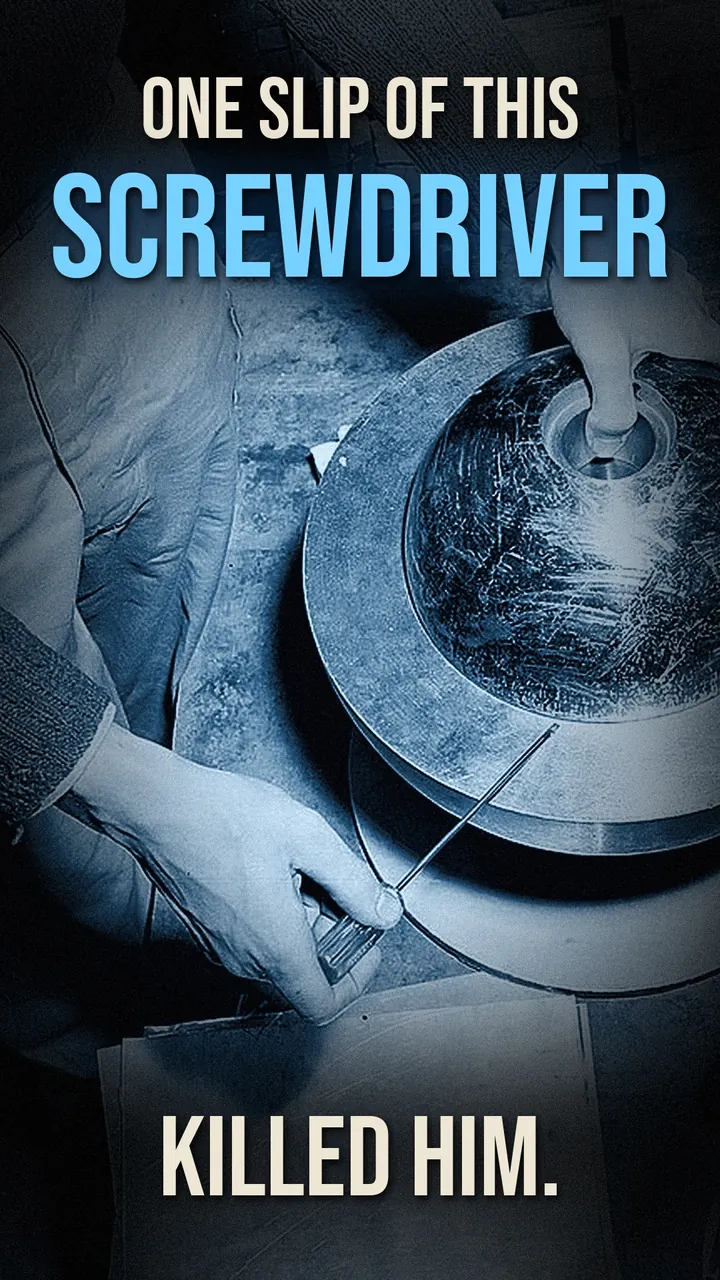
Los Alamos, 21 May 1946. Louis Slotin, the Canadian physicist who assembled the core of the first atomic bomb, is about to leave the lab and is showing his replacement a dangerous test: lowering a beryllium dome over a ball of plutonium, keeping the halves apart with the blade of a screwdriver instead of the spacers the rules called for. Scientists called it "tickling the dragon's tail". At 3:20 p.m. the screwdriver slipped. A blue flash, a wave of heat. Slotin knocked the dome away in less than a second, but he had already taken a lethal dose. He died nine days later, aged 35. Everyone else in the room survived the accident. The same core had already killed Harry Daghlian in 1945, and after Slotin it became known as the "Demon Core". Hands-on criticality experiments were stopped; machines took over, operated from a quarter of a mile away.
The facts behind this file
What the record shows
- Louis Slotin assembled the core of the Trinity bomb in July 1945, and in 1946 was training his replacement, Alvin Graves.
- In the test, a beryllium dome was lowered over a plutonium core. Instead of the required spacers, Slotin held the gap open with a screwdriver; he had done this almost a dozen times.
- On 21 May 1946 at about 3:20 p.m. the screwdriver slipped. He knocked the dome away within about half a second, but died on 30 May 1946, aged 35.
- The same core had killed Harry Daghlian, who dropped a tungsten carbide brick onto it on 21 August 1945. Afterwards it became known as the 'Demon Core', and hands-on experiments were replaced by remote-controlled machines operated from a quarter of a mile away.
Legends, disputes & careful wording
- Enrico Fermi's warning that he would be dead within a year, and Slotin's words 'Well, that does it', are both reported second-hand.
- Sources disagree on whether seven or eight people were in the room. All survived the acute effects; some had long-term health problems.
- The photos in the episode are a Los Alamos reconstruction of the experiment. The blue glow is a modern reactor (Idaho National Laboratory), shown as an illustration.
Main sources
- Los Alamos reports; Hempelmann et al. (1979)
- Wikipedia: Louis Slotin; Demon core
Spotted a mistake or know a better source? Tell us.
Further reading
As an Amazon Associate, Inventor Files earns from qualifying purchases. It costs you nothing extra.
Image & film credits
- Photos (public domain, U.S. government / Los Alamos National Laboratory, via Wikimedia Commons): reconstruction photos of the Slotin criticality experiment ("Slotin accident mockup" series, "The demon core", "Tickling the Dragon's Tail"), Louis Slotin's Los Alamos ID photo, Louis Slotin and the Gadget (July 1945), Louis Slotin and Harry Daghlian (1945), Herbert Lehr and Harry Daghlian (July 1945), the dose diagram of the Pajarito accident and a Los Alamos drawing of the accident, Alvin C. Graves (1957), Enrico Fermi (1943–49), the Tech Area at Los Alamos (c. 1945), the Los Alamos Ranch School area (U.S. Department of Energy).
- The Advanced Test Reactor at Idaho National Laboratory (2014, public domain, Idaho National Laboratory via Wikimedia Commons).
- Film: the Trinity test, 16 July 1945 (public domain).
- Video clips from Pexels. Narration: ElevenLabs (voice "George"). Music made for this video.